Loading page
Restrict Delete, Export & Print by User Group
by TechnoVision · Odoo App
Decide who may delete, export and print.
Odoo's access rights are per-model and per-operation, which sounds like enough until you try to use them. Pick a model, list the groups that may still act, and everyone else is refused with a message you write.
One-off licence per Odoo instance. The store bills in its own base currency, so checkout may differ by a few cents. That is the add-on price. Installation and support are optional and priced separately.
- Odoo 18 & 19
- Community & Enterprise
- Multi-company
- Version 18.0.1.0.7 · 2026-09-11
Security Center
Live82
Score
1.2k
Events / 24h
3
Alerts
Export volume · 14 days
Unusual export detected
res.partner · 4,812 rows · outside business hours
Illustrative UI. Product screenshots to be dropped into this frame.
What it does
Five operations, restricted independently, per model
Five operations
Delete, export, print, archive and duplicate - each restricted independently, and delete covers unlink from the interface, the API or a server action.
Allow-list by design
Once a rule restricts an operation, only the listed groups may perform it. A deny-list stops being verifiable the moment a user belongs to several groups.
A refusal that explains itself
You write the message. "Archive the contact instead, or ask a Contact Manager" generates far fewer support tickets than a bare Access Denied.
Blocked attempts log
Who, when, which operation, which records and from which address - so you can find the rule that is getting in the way rather than the person.
Cannot lock you out
The superuser always bypasses and this cannot be switched off. Settings-group users bypass by default until you turn that off deliberately.
Critical models are refused
res.users, res.groups, ir.model.access and ir.rule can never be restricted, and neither can the app own records. Python-level guarantees, not settings.
Fails open
If the configuration cannot be read, the operation proceeds. A monitoring bug must not become a business outage.
Costs nothing to read
A cached lookup that returns immediately for any model without a rule. It runs on delete, copy and archiving writes only - never on reads or ordinary edits.
Two roles
Viewers read the rules and the log. Managers create and change rules and clear the log.
Pricing & Services
Three things you can pay for. Only the first one is required.
The add-on licence is the product. Installation and a support plan are separate, optional, and neither is added to anything unless you choose it. The licence is bought into your own account, so you own it outright whether or not you ever buy a service from us.
Add-on License
RequiredThe module, bought from the Odoo Apps Store into your own account.
$25
one-off, per Odoo instance · paid to the Odoo Apps Store
Buy Add-onIncludes
- The module itself, for one Odoo instance, with no user limit and no expiry
- Every 18.0 release of the module, including security fixes
- The module documentation, in the module and on this site
- Defect fixes and help with configuration, at no extra cost and with no support plan required
Not included
- Installation on your instance, and configuration against your data
- Changes to the module for your own requirements
- Migration of the module or your data to another Odoo series
- Work on your Odoo, your server, your network, or on other vendors’ modules
Installation & Configuration
OptionalThe rules have to be agreed with you per group, or they block the wrong people.
$249
one-off · paid to TechnoVision
Add InstallationIncludes
- Remote installation on your instance
- Configuration walked through with you, against your own data
- Compatibility verification against your Odoo version and edition
- Testing of the main workflows end to end
- A short written handover of what was configured and why
- 30 days of support after handover
Not included
- Changes to the module’s behaviour for your own requirements
- Data import, data cleaning or historical back-fill
- Training sessions beyond the handover walk-through
- Work on your Odoo, your server or other vendors’ modules
- Redesign of the business process the module reports on
Support Plan
OptionalTwelve months of updates and help with the module, on top of what every licence already includes.
$150
per 12 months · paid to TechnoVision
Choose SupportIncludes
- Twelve months of module updates, including security fixes
- Configuration support by email
- Priority handling: your ticket is looked at before unpaid enquiries
- Help reproducing and reporting a defect, and a fix or a workaround
Not included
- Your Odoo, your server, your network, your backups, or other vendors’ modules
- Custom development or changes to how the module behaves
- Migration to another Odoo series — 18.0 to 19.0 is a project, not a ticket
- On-site attendance, and work outside the hours below
- Anything an external vendor charges for
What is included with every licence, at no extra cost
A support plan adds to what you already have. It never replaces it: defect fixes and help with the module stay free for every licence holder, plan or no plan.
- Defect fixes, at no charge, for the life of the 18.0 series
- Help when the module does not behave as its description says it does
- Answers to configuration questions about the module itself
- Security fixes, released to everyone whether or not they hold a support plan
Support plan terms, as numbers rather than adjectives
- Up to 10 support requests in the twelve months
- Up to 4 hours of remote assistance in total
- One Odoo minor-version upgrade of the module, within the same series
- Response within 2 business days, Sunday to Thursday, Cairo time
- Covers the module. It does not cover your Odoo, your server, your network, or work on other modules.
- The plan runs for 12 months from the day it starts and then stops. It renews only if you ask us to renew it — nothing renews automatically and no card is stored.
Supported: Odoo 18 and 19, Community and Enterprise. Licensed per Odoo instance, with no user limit and no expiry. Prices exclude any tax that applies where you are, and we tell you before you pay if any is due.
Demo
0:11 of the real thing
Recorded from a running Odoo 18 with real records. No slides, no mock-ups, and nothing sped up.
Screenshots
Product gallery
3 captures of the shipped product: restriction rules, rule form, blocked attempts.
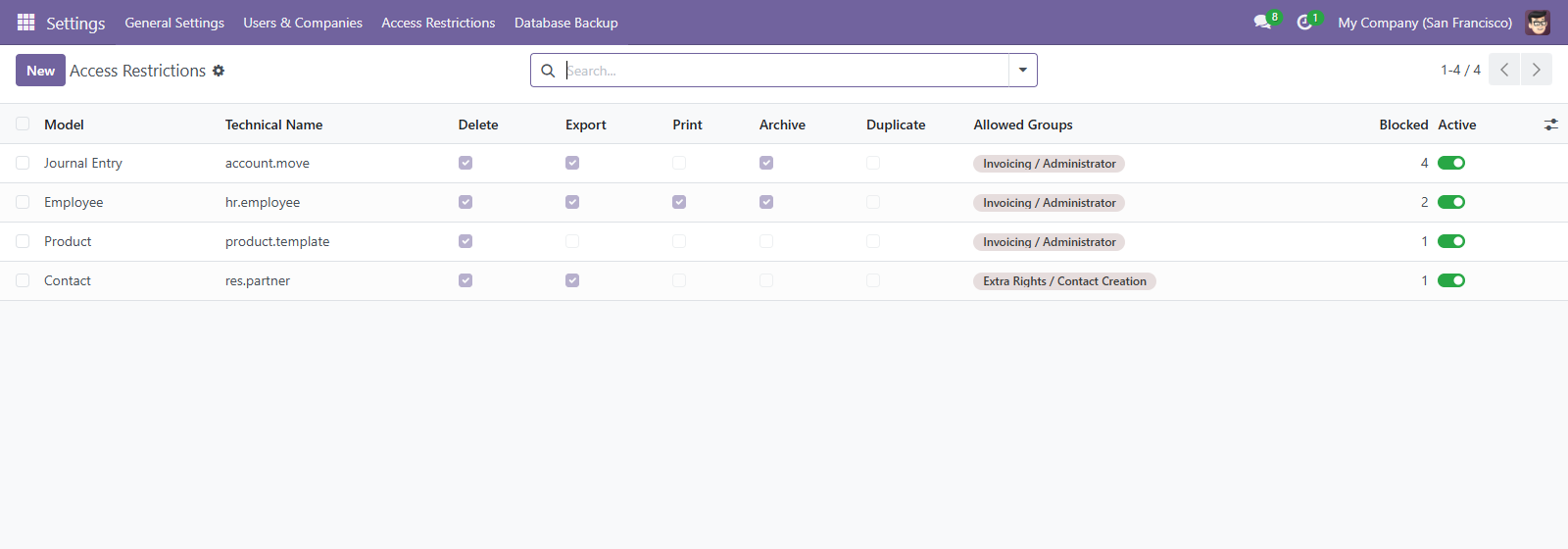
Restriction rules
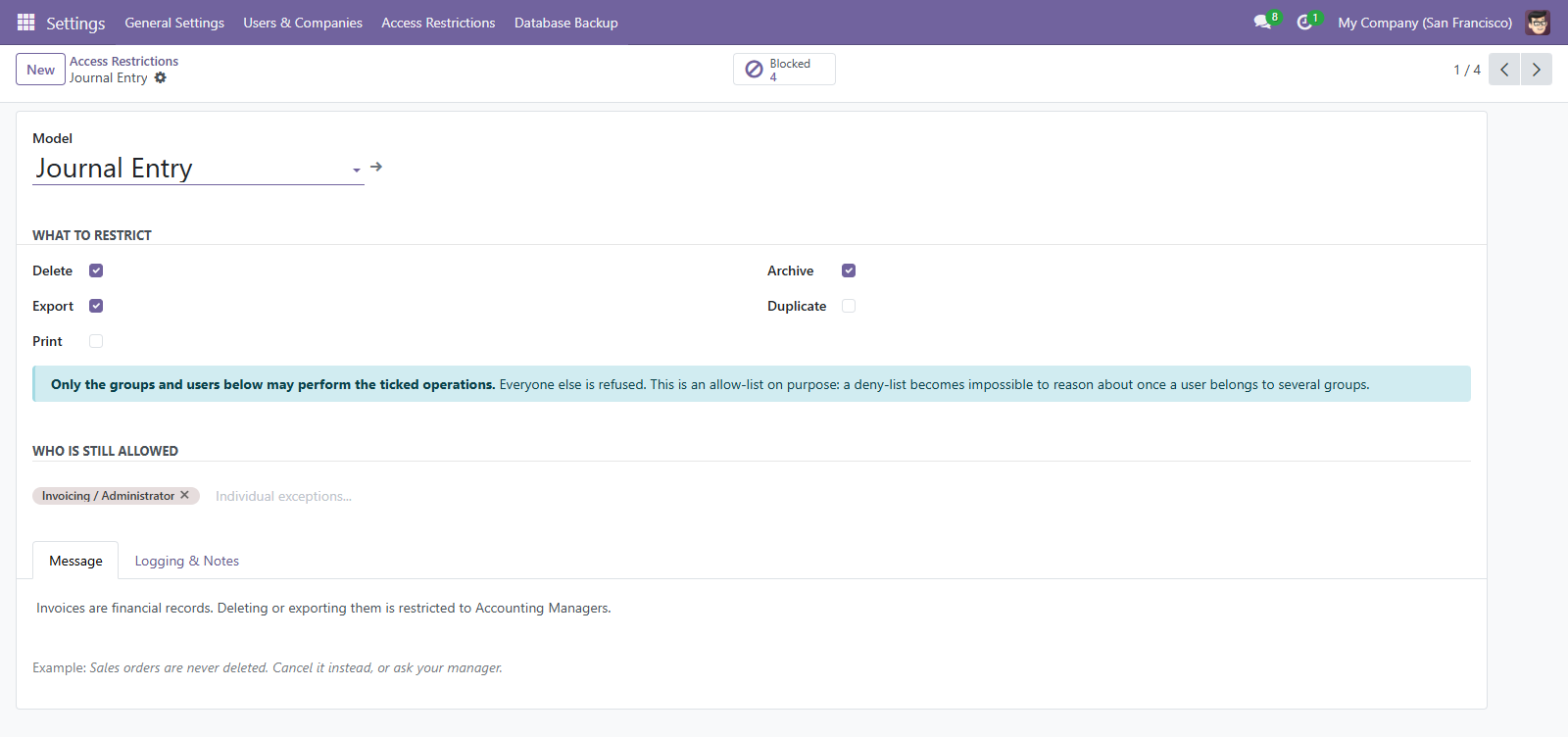
Rule form
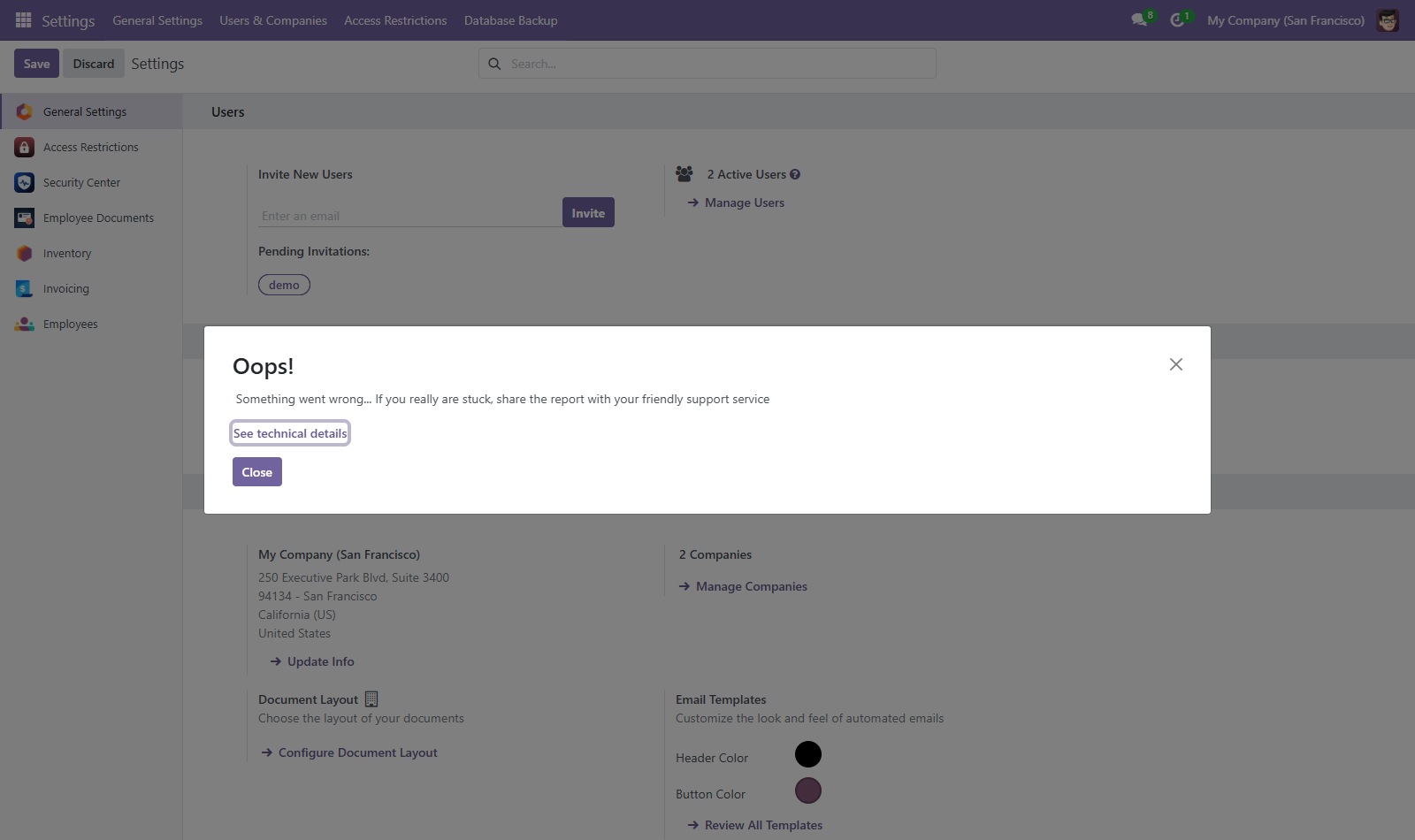
Blocked attempts
How it works
Installed in minutes, useful the same day
- 1
Install the app
Depends on base and web only. No external Python packages, no outbound connections.
- 2
Pick a model
Settings - Technical - Security - Access Restrictions. Tick the operations that should be controlled.
- 3
List who may still act
Name the groups and users that keep the permission, and write the message everyone else will see.
- 4
Read the log
Blocked attempts show which restrictions are costing people time, so rules can be corrected rather than endured.
FAQ
Questions we get asked
No. The superuser bypass cannot be disabled, critical models are refused by the form, and the app own records can never be restricted - so a rule can always be undone.
No. Custom controllers, XML-RPC and JSON-RPC, and third-party report engines do not pass through the monitored funnel. Deletes performed with raw SQL are also unaffected - nothing at the ORM level can be.
A cached lookup that returns immediately for models without a rule, on delete, copy and archiving writes only.
This one stops the operation; that one records everything that did happen, with a Security Score and alerting. Neither requires the other.
The module itself, for one Odoo instance, with no user limit and no expiry; every 18.0 release of the module, including security fixes; the module documentation, in the module and on this site; and defect fixes and help with configuration, at no extra cost and with no support plan required. It is a one-off licence for one Odoo instance, with no user limit and no expiry. It does not include installation on your instance, and configuration against your data; changes to the module for your own requirements; migration of the module or your data to another Odoo series; and work on your Odoo, your server, your network, or on other vendors’ modules.
No, and it is not hidden in the price either. Installation and configuration is a separate, optional service at $249 one-off. It covers remote installation on your instance; configuration walked through with you, against your own data; and compatibility verification against your Odoo version and edition. If you or your partner install Odoo modules already, buy the licence on its own and skip it — most buyers of a module this size do.
Odoo 18 and 19, on Community and Enterprise. We do not claim a series until there is a branch for it, its tests pass on that series, and somebody has run it there — so the list on this page is what is actually supported rather than what is planned.
Twelve months of module updates, including security fixes; configuration support by email; priority handling: your ticket is looked at before unpaid enquiries; and help reproducing and reporting a defect, and a fix or a workaround. It runs for twelve months at $150 and is bounded by stated limits rather than by the word "reasonable": Up to 10 support requests in the twelve months; up to 4 hours of remote assistance in total; one Odoo minor-version upgrade of the module, within the same series; response within 2 business days, Sunday to Thursday, Cairo time; and covers the module. It does not cover your Odoo, your server, your network, or work on other modules.. The plan runs for 12 months from the day it starts and then stops. It renews only if you ask us to renew it — nothing renews automatically and no card is stored. It does not cover your Odoo, your server, your network, your backups, or other vendors’ modules; custom development or changes to how the module behaves; migration to another Odoo series — 18.0 to 19.0 is a project, not a ticket; on-site attendance, and work outside the hours below; and anything an external vendor charges for.
No, and this is the line worth being clear about. Defect fixes, at no charge, for the life of the 18.0 series; help when the module does not behave as its description says it does; answers to configuration questions about the module itself; and security fixes, released to everyone whether or not they hold a support plan — all of that comes with the licence, for every buyer, at no extra cost and whether or not a plan is ever bought. A paid plan adds updates, priority over unpaid enquiries and an allowance of assistance hours on top. It never takes anything away.
No, in any of the three options. A change to how a module behaves, a migration between Odoo series, and connecting a system we do not publish a connector for are each their own piece of work, quoted on their own. They are listed as exclusions on the cards rather than left to be discovered: they are the three things buyers most often assume are covered.
Use the buttons in the Pricing & Services section above. Both have a price, so the button takes you to a short form, shows you the total and what it covers before you commit, and creates a numbered order we reply to. No card details are taken on this site, and nothing is added to anything unless you choose it.
Get Restrict Delete, Export & Print by User Group
Install from Odoo Apps, or talk to us about a guided rollout across multiple companies.